Blog
The Complete Guide to Brand Monitoring in 2026
13 min readUpdated
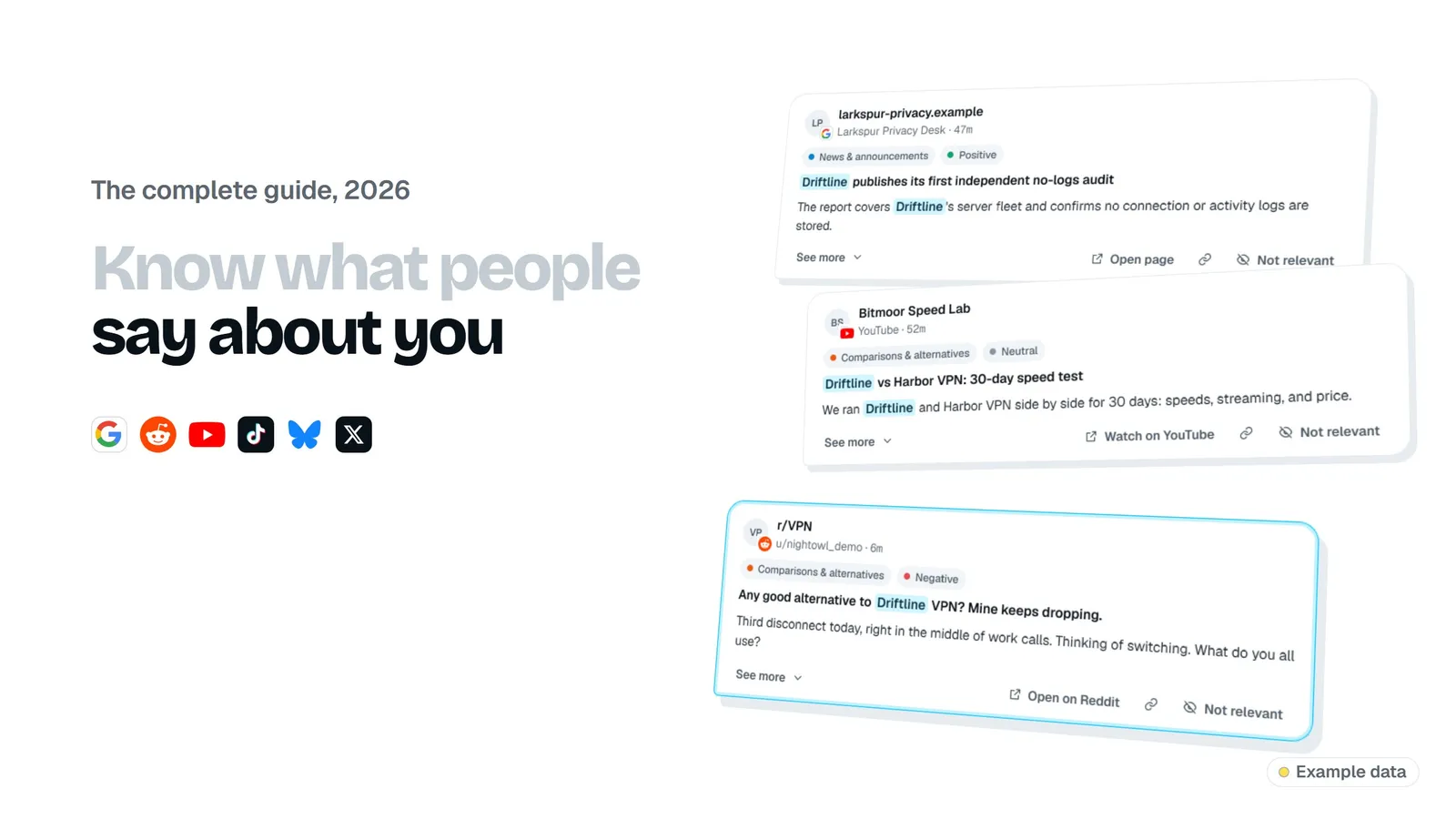
What is brand monitoring? Brand monitoring is tracking what people say about your brand, your products and your competitors online: on news sites, blogs, forums, Reddit, YouTube and social media. A monitoring tool searches those places for your keywords and collects each mention in one feed, so you can see what was said, where, and whether it needs a reply.
In this guide:
- What brand monitoring is, and why the stakes are higher in 2026 than they were two years ago
- The five types of mentions that matter, including Reddit and YouTube, which most monitoring guides leave out
- Why authority scoring is the difference between useful monitoring and inbox noise
- How to configure monitoring correctly from day one: keywords, filters, exclusions, and competitor tracking
- A seven-step setup checklist you can follow today
- How to build an action workflow around your monitoring data
- Common setup mistakes to avoid, and what to do instead
Brand monitoring is the practice of tracking what people say about your brand, your products, and your competitors across the web. It covers blog posts and news articles, forum threads and Reddit discussions, YouTube video mentions, and social media. The goal is straightforward: know what is being said, where it is being said, and how much it matters, before that information finds you on its own terms.
In 2026, this is not optional for serious teams. According to reputation data compiled by Passive Secrets, 90% of consumers read online reviews and mentions before visiting a business, and 94% will abandon a brand after a single bad experience. The same research shows that brand reputation accounts for up to 30% of FTSE 350 companies’ market value. That dynamic applies at every scale: an unmonitored mention on a high-traffic Reddit thread or a YouTube video with tens of thousands of views can shift how a segment of your market perceives your product before you ever know the conversation happened.
Brand monitoring gives you visibility. What you do with that visibility is strategy.
What Brand Monitoring Is and Why It Matters More in 2026
Brand monitoring means systematic tracking of any reference to your brand name, product names, key personnel, or branded phrases across the internet. It is distinct from social listening, which focuses primarily on social platforms. Brand monitoring is broader: it captures mentions from news sites, blogs, review platforms, community forums, video platforms, and the open web.
The reason it matters more now than it did even two years ago comes down to two structural shifts.
First, search engines increasingly use brand signals as quality indicators. Moz’s research on brand authority shows that Google rewards well-known brands with expanded SERP features, including sitelinks, Knowledge Graph entries, and duplicate rankings on page one. Brands that appear frequently and consistently in credible third-party sources build what Moz calls Brand Authority, a measurable signal that compound over time. You cannot build that signal if you do not know where it is happening.
Second, community-driven platforms have become primary research channels. Buyers no longer rely on branded content alone. They check Reddit threads, YouTube reviews, and niche forums to get unfiltered opinions before they make a decision. If you are not monitoring those conversations, you are operating blind on the channels that now influence the majority of purchase decisions.
Brand monitoring is relevant for marketing managers running demand generation, PR consultants managing client reputation, agency owners tracking deliverables, indie makers watching product launches, and brand managers who need to justify how brand investment translates to outcomes.
The Five Types of Mentions That Actually Matter
Not all online mentions carry the same weight, and not all monitoring setups capture the right sources. Understanding the categories helps you configure alerts that surface what is actually worth your attention.
Web mentions are the broadest category and include blog posts, product reviews, comparison pages, and editorial content. They tend to have the longest lifespan: a blog post mentioning your product may rank in search results for years and continue driving referral traffic. Web mentions from authoritative domains also contribute directly to your backlink profile and brand authority signals.
News mentions are high-impact and time-sensitive. When a journalist covers your industry, cites your product, or reports on something your company is involved in, the window to respond is short. News mentions carry significant authority and can shape public perception quickly, in either direction. Catching a negative news mention within hours is a fundamentally different situation from catching it three days later.
Forum and community mentions, including Reddit and niche discussion boards, are where the most honest conversations about your brand happen. Reddit is especially important in 2026 because it ranks prominently in search results for product-comparison and recommendation queries. When someone asks “has anyone tried [your product]?” in a relevant subreddit, that thread may surface in Google results for years. Challenger brand research from Commit Agency describes Reddit as “where your market tells the truth” and notes that both direct brand mentions and indirect recommendations, where someone is described as solving a problem without naming a brand, are valuable for reputation intelligence. Missing this channel is one of the most common gaps in brand monitoring setups.
YouTube mentions represent a growing and undermonitored source. Product reviews, comparison videos, tutorial content that name-drops your tool, and sponsored unboxings all shape perception at scale. A YouTube video with 50,000 views and a negative take on your product is a meaningful reputation event. Monitoring for your brand name in video descriptions, titles, and creator commentary is no longer optional for product-led brands.
Social media mentions are the most visible and the most volatile. A post can gain traction faster than any other format, which means the gap between when something is posted and when you respond matters. Social monitoring helps you catch momentum early enough to engage, clarify, or amplify, depending on what the situation calls for.
Why Authority Scoring Changes How You Work
Here is a scenario that anyone who has run brand monitoring without filters will recognize: you open your alerts one morning to find 60 new mentions. Some are spam. Some are low-traffic blogs republishing a press release verbatim. A handful are genuine discussions on high-credibility platforms. One is a major industry publication. All of them arrived in the same inbox, with no signal about which one deserves attention first.
Authority scoring solves that problem. Instead of treating every mention as equally important, a scoring system rates each mention based on the credibility and reach of the source. MentionPilot works toward the same goal in a different way: AI reads every mention and hides off-topic results and spam, which do not count toward your mention limit and stay available if you want to review them. Every mention that remains, whatever its source, gets a category (such as a question, a complaint, a review, or buying intent) and a tone, and you can sort the feed by engagement or put the most negative mentions at the top.
A mention on a domain with strong backlinks, substantial traffic, and editorial credibility deserves a high rating. A mention on a newly registered blog with no audience gets a low one. This single layer of prioritization changes how you use monitoring data in practice. Instead of auditing every result, you scan your highest-priority mentions first, respond where necessary, and work down the list based on available time and capacity.
For teams managing multiple brands, product lines, or client accounts, authority scoring is the difference between monitoring being a useful daily habit and a task you avoid because it takes too long to process.
How to Set Up Effective Brand Monitoring
The biggest mistake people make when setting up monitoring for the first time is configuring it too broadly. If your brand name is a common word or shares a name with something unrelated, an unfiltered alert will bury signal under noise within days. Good setup practice solves this before it becomes a problem.
Start with exact-match brand terms. Monitor your brand name, your primary product names, and any branded phrases that are unique to your business. These are your highest-priority alerts and should be set up first.
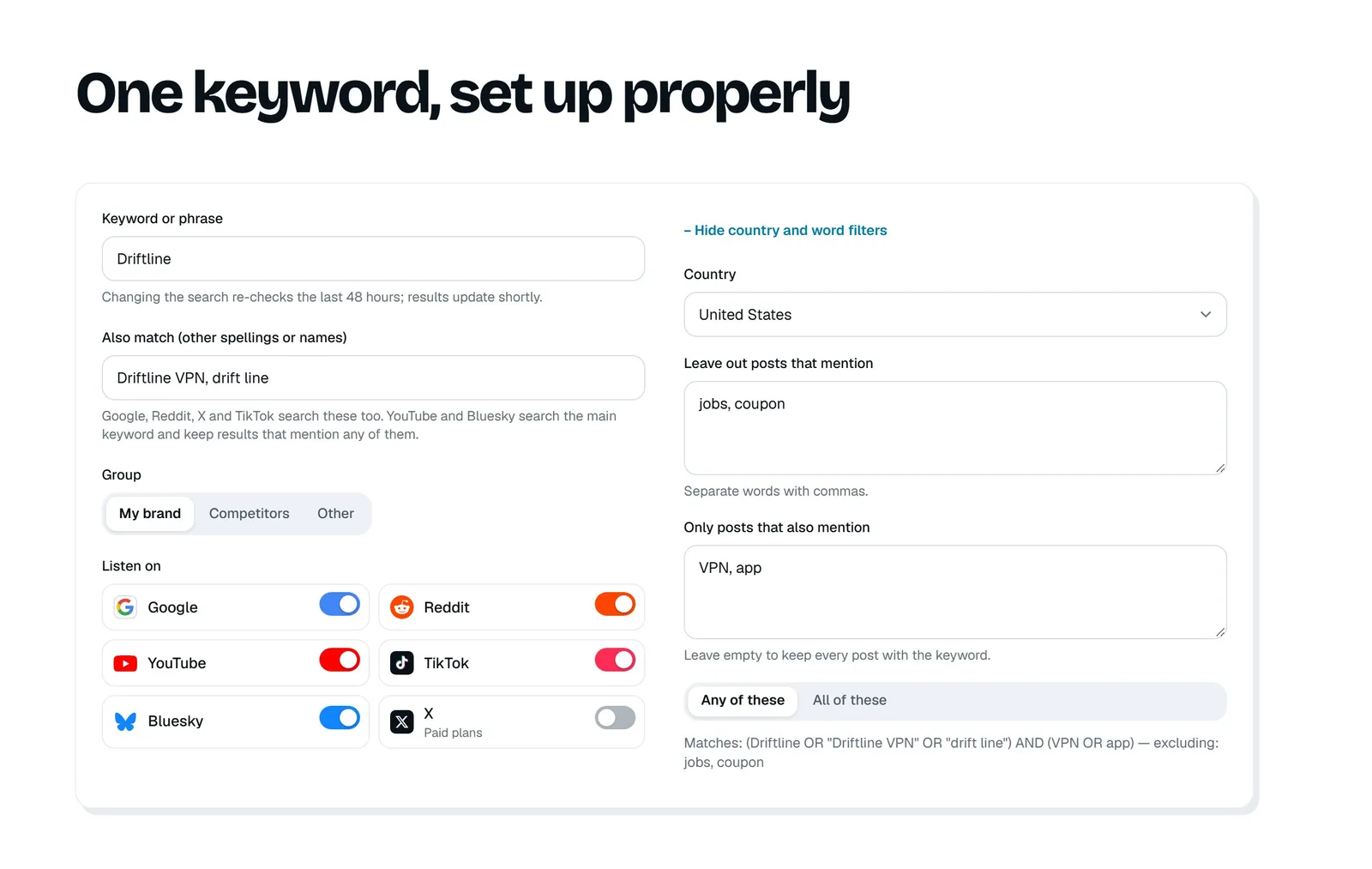
Layer in negative keywords. Identify terms that consistently produce irrelevant results alongside your brand name and add them as exclusions. If your brand name is also a common noun or shares a name with a sports team, city, or unrelated company, negative keyword filters are essential to keeping results clean. In MentionPilot, each keyword can also list other spellings, words a post must include, and words that rule a post out.
Exclude your own properties. You do not need alerts every time your own blog publishes a post or your own social profiles reference your brand. Most monitoring tools let you keep specific domains out of your results. Exclude your own website, your owned social profiles, and any press distribution services you use. In MentionPilot, you add your own domains in project settings, which keeps your own site apart from the mentions about you.
Add competitor monitoring. Tracking your competitors’ mentions gives you market intelligence that is genuinely hard to get any other way. You can see which publications are covering them, which communities are discussing their products, and where they are being criticized. All of that intelligence informs your own positioning and content strategy.
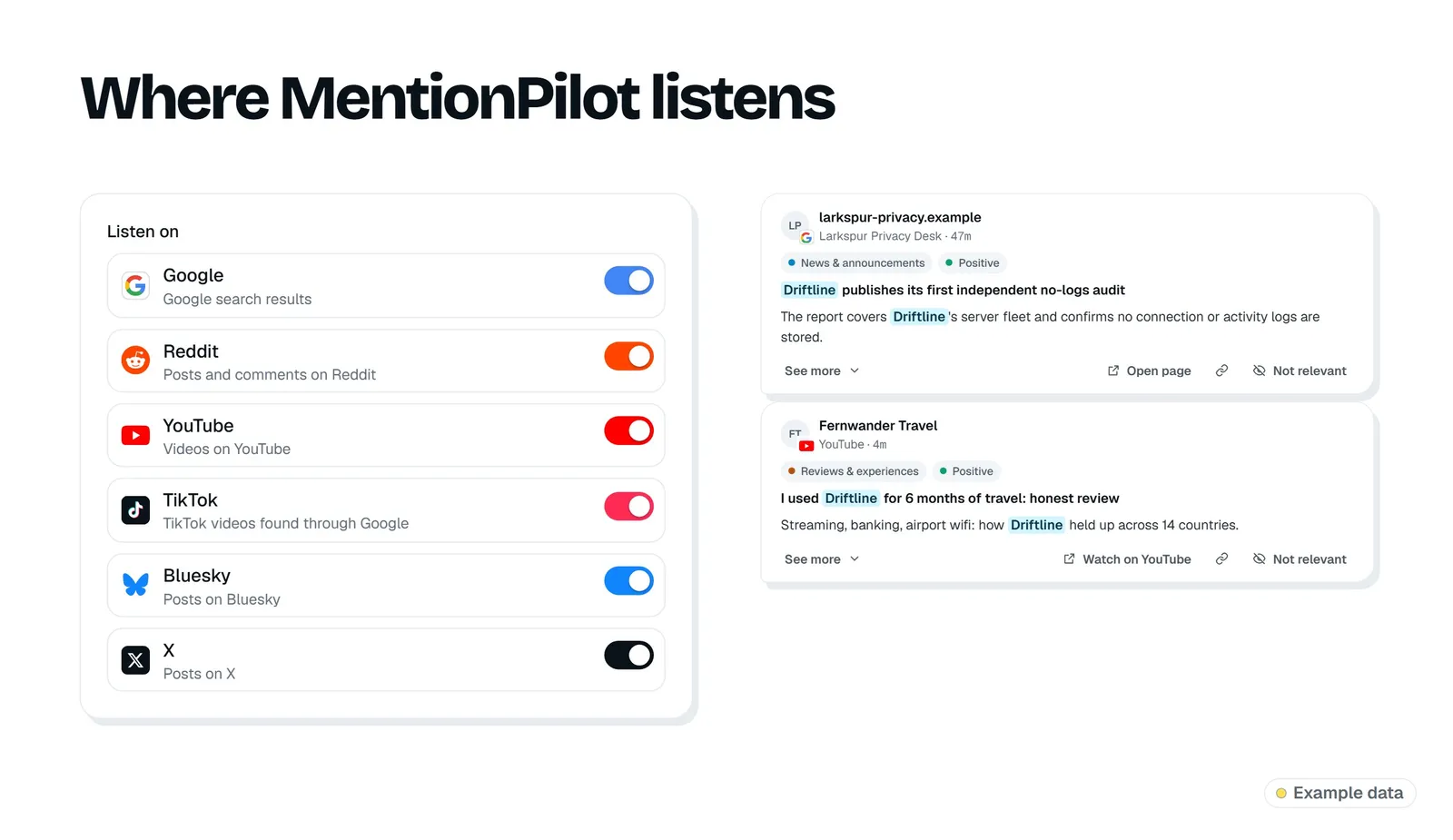
Use source type filters. Not every monitoring need requires every source type. A local service business may care far more about review site and local news mentions than about Reddit or YouTube. Filtering by source type keeps your digest focused on what is actually relevant to your business. MentionPilot lets you choose, per keyword, which sources to search: web pages found through Google (including news sites, blogs, and forums), Reddit posts and comments, YouTube, TikTok videos that Google has indexed, Bluesky, and X.
Consider geographic targeting. If your business operates in specific markets, geographic filters ensure you are seeing mentions from those regions rather than unrelated results from other countries with similar brand names or terminology. In MentionPilot, you set the country Google and YouTube search in for each keyword.
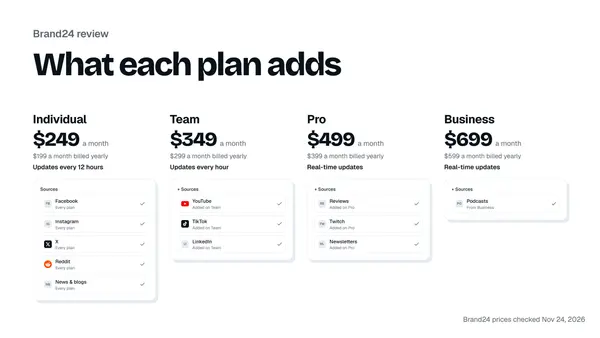
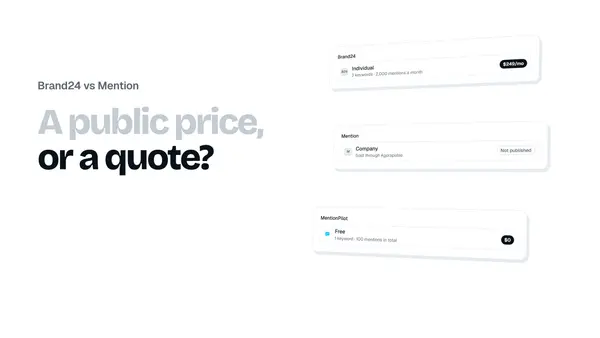
Compare tools on what they publish. Before you pay for a tool, check that its price and limits are public. Mention pricing, for example, is no longer shown on its website, and our Brand24 vs Mention comparison shows what two well-known tools include.
For a closer look at how MentionPilot handles keywords, sources, and notifications, see the MentionPilot features page.
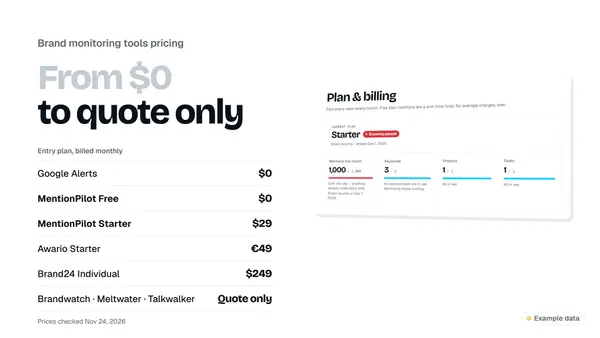
Still choosing a tool? Our brand monitoring tools pricing comparison puts 15 tools side by side, and our Brand24 review covers one of the best-known paid options in detail.
Brand Monitoring Setup Checklist
Use this list the first time you set up brand monitoring, and again whenever your results get noisy.
- List your keywords. Your brand name, product names, branded phrases, and the misspellings people actually use.
- Add your main competitors. Give each one its own keyword and put them in a separate group from your brand, so the numbers stay apart.
- Pick the sources for each keyword. Decide where each keyword is searched (web, news, forums, Reddit, YouTube, social media) and, where it matters, in which country.
- Filter out the wrong meanings. If your name is a common word, add words a post must also include, and words that rule a post out.
- Exclude your own sites. Add your website and your own profiles, so your own posts do not crowd out what other people say about you.
- Choose how you hear about mentions. A daily or weekly digest for routine reading, plus faster alerts for the mentions that cannot wait, such as negative posts or buying intent.
- Review after the first week. Mark off-topic results, tighten your filters, and agree who on the team replies to what.
How to Turn Monitoring Data Into Action
Monitoring data is only useful when it connects to a workflow. The teams that get the most value from brand monitoring are not necessarily monitoring more: they have a clearer process for deciding what to do with what they find.
Prioritize by authority, then by sentiment. Start with high-authority mentions. Within that set, distinguish between positive mentions worth amplifying, neutral mentions worth engaging with, and negative mentions that require a response. Not every mention needs a response, but every high-authority negative mention does.
Respond to substantive mentions within 24 hours. A major publication covers your product. A credible YouTube creator recommends it in a roundup. A high-traffic Reddit thread surfaces a question about your pricing. These are all moments worth acknowledging. Responding within a day, whether to thank, clarify, or contribute to the conversation, signals that your team is engaged and credible.
Address negative mentions before they compound. A single negative review or critical thread rarely causes lasting damage on its own. What causes lasting damage is inaction: when a problem surfaces on a visible platform and the brand never engages, the silence becomes part of the narrative. Research from NewMedia.com shows that brands that respond to negative mentions before they escalate can reduce reputation recovery time by up to 50%.
Build monitoring into regular reporting. Monthly reporting on brand mentions, sorted by source type and authority tier, gives marketing and leadership a clear view of how brand presence is trending. Are high-authority mentions increasing? Are they skewing positive or negative? Are new platforms or communities surfacing as relevant? This data feeds into decisions about content, PR outreach, and product positioning.
Set up team access with clear ownership. For teams with multiple people involved in communications, marketing, or customer success, role-based access ensures that the right person sees the right alerts. MentionPilot projects have Owner, Editor, and Viewer roles (Pro and Scale include several seats), and alerts let you send specific kinds of mentions (say, problems or buying intent) to the teammate who acts on them, by email in a daily summary at a set time, or to Slack as they arrive or once a day (Slack works on every plan, Free included), which means a PR manager can receive a different alert cadence than a product manager or founder.
Export data for deeper analysis. For reporting periods or due diligence, MentionPilot can turn a filtered set of mentions into a shareable report link, with an optional password or expiry date. Paid plans can also pull mentions through the REST API or receive them by webhook, which lets you run your own analysis or bring data into reporting tools outside the platform.
Common Mistakes to Avoid
Even well-configured monitoring setups run into a few recurring problems. The most common ones are worth knowing in advance:
Setting alerts too broadly and never cleaning them up. Noise accumulates fast. Unused alerts that return irrelevant results are not neutral: they train teams to stop checking, which defeats the purpose of monitoring entirely.
Monitoring your brand but not your competitors. Competitive mentions are some of the most actionable data in any monitoring setup and are frequently ignored.
Treating all mentions as equal. Without authority scoring, important mentions get buried. Triaging manually takes time that most teams do not have.
Checking monitoring reactively instead of on a schedule. Daily digests, like the ones MentionPilot sends at the time you choose (weekly if you prefer), solve this by bringing data to you rather than requiring you to log in and remember to check.
Setting up monitoring without exclusions for your own properties. The first time your own homepage triggers 15 alerts, you understand why domain exclusions matter.
FAQ
What is brand monitoring, and how is it different from social listening?
Brand monitoring tracks mentions of your brand across the full web, including news sites, blogs, forums, Reddit, YouTube, and review platforms. Social listening is a subset focused primarily on social media platforms. Brand monitoring gives you a broader view of how your brand is being discussed across different channels and content types.
How often should you check your brand monitoring results?
A daily check is sufficient for most teams. Tools that deliver a daily email digest remove the friction of logging in and remembering to check, which makes consistent monitoring easier to maintain. For time-sensitive situations, like a product launch or an ongoing press story, daily cadence is especially important.
What keywords should you monitor besides your brand name?
Monitor your primary product names, any unique branded phrases, your key personnel’s names if they are publicly associated with the business, and your main competitors. Common misspellings of your brand name are also worth including if they appear regularly in search results.
How do you handle a negative mention once you find it?
Respond promptly, keep the response factual and constructive, and take the resolution conversation offline when appropriate. A calm, professional public response to a negative mention often does more for your reputation than the original criticism did against it. Ignoring high-visibility negative mentions consistently is what causes lasting damage.
Does brand monitoring help with SEO?
Yes, in several ways. Monitoring helps you find unlinked mentions of your brand, which you can then convert into backlinks through direct outreach. It also helps you track which content formats and platforms are generating coverage, informing your content and digital PR strategy. Brand authority, as Moz documents in their Brand Authority research, is an increasingly important signal in how search engines evaluate and rank brands.