Why Google Alerts Stopped Working (And What to Switch to Instead)
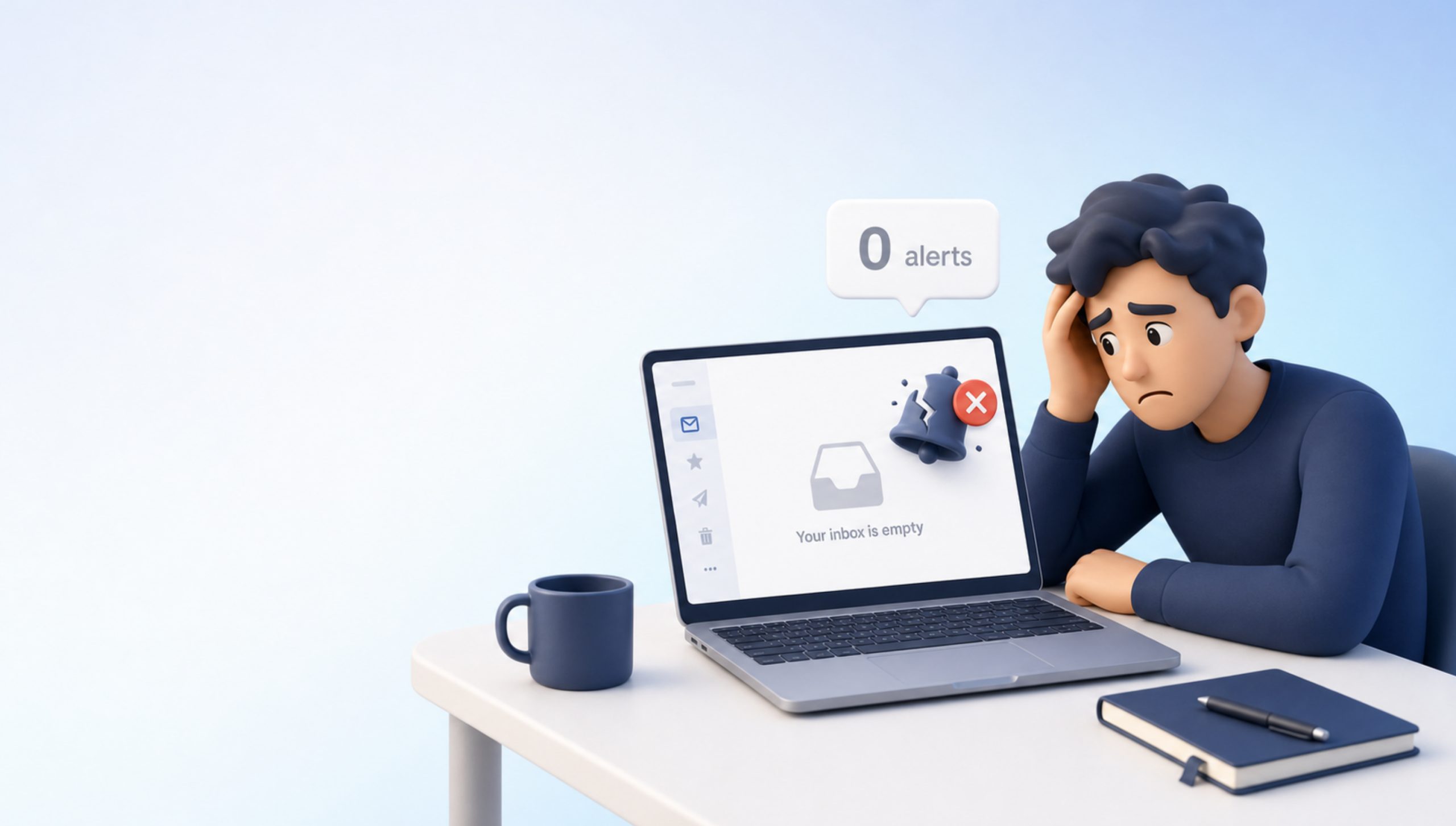
The short answer: Google Alerts has not been a reliable brand monitoring tool since around 2012. It misses an estimated 40% of relevant mentions, has no filtering, delivers no analytics, and its results are gated by Google’s search index rather than the open web. If you need to know when people are talking about your brand, Google Alerts will let you down. Purpose-built tools like MentionPilot cover Google, Reddit, YouTube, news sites, blogs, and forums daily and give you authority scoring, filters, and exportable data, starting free.
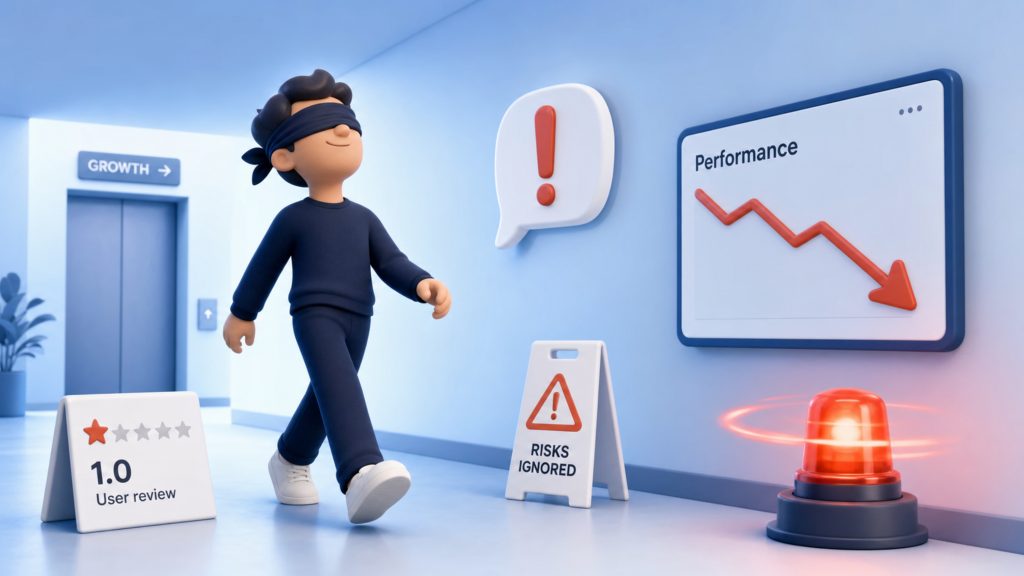
Google Alerts stopped working reliably around 2011–2013, and it has never recovered. Independent testing found that only about 10% of delivered alerts are actually relevant, and roughly 40% of the mentions that matter never arrive at all. If you are still using Google Alerts as your primary brand monitoring setup, you are flying mostly blind. This article explains why that is, and what to use instead.
Why Google Alerts Has Gotten Worse Over Time
Google Alerts was built to solve a specific problem: notify you when Google finds a new page containing your keyword. In the early days, that worked reasonably well because Google was aggressively indexing everything it could find.
The product’s decline is a side effect of Google Search getting better. Modern Google is optimized to surface the most relevant page for a query, not to index every page that exists. That is great for people using Google to find answers. It is terrible for brand monitoring, where the goal is comprehensive coverage, not editorial selection. Google’s internal filters, designed to reduce noise in search results, now suppress a significant share of legitimate mentions before your alert ever fires.
The interface has not been meaningfully updated in years. There is no dashboard, no history, no way to know what you missed. Google has never officially deprecated Alerts, but the product tells its own story.
The Specific Ways Google Alerts Fails Brands
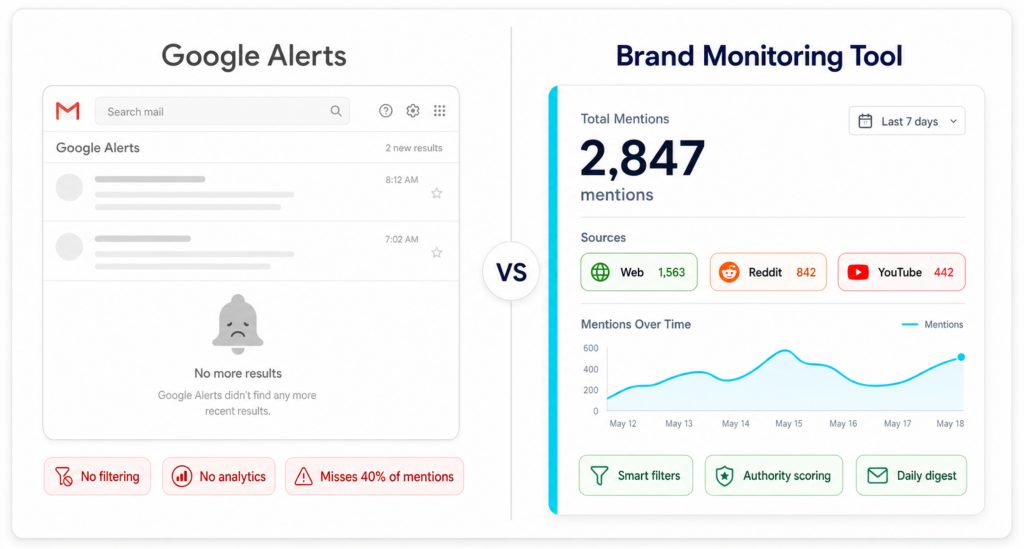
This is the core problem. Independent testing by Contify, covering 240 company alerts, found that 40% of business-relevant mentions never arrived as alerts at all. A more recent analysis from Salesmotion confirmed the same structural gap: only 10% of delivered alerts were business-relevant, and around 40% of relevant news was missed entirely. In a survey of 230 market intelligence professionals, 92% said they could not rely on Google Alerts because important updates were getting missed.
Forum posts, niche blogs, regional news sites, and Reddit threads are routinely skipped. Mentions on smaller publications that Google has not prioritized for crawling may arrive days late or not at all.
There Is Zero Filtering
Google Alerts gives you one lever: the keyword. You cannot exclude domains, filter by source type, block your own website from appearing in your own results, or suppress irrelevant industries that happen to share your brand name. If your company name is a common phrase, you will spend more time deleting noise than reading real mentions. There is no way to fix that within Google Alerts.
No Context, No Prioritization, No Analytics
Each alert delivers a link and a snippet. That is the full feature set. There is no way to tell at a glance whether a mention is from a high-authority publication or a spam blog. There is no volume tracking over time, no export capability, and no reporting. If someone asks how many times your brand was mentioned last month, Google Alerts cannot answer that question.
Delivery Is Unreliable by Design
Even the “as-it-happens” setting is misleading. Google’s own documentation confirms that alerts fire when Google finds matching results, not when the content is published. That means alerts are gated by Google’s indexing pipeline, which can take hours or days for smaller sites. For forums and community posts, the delay is frequently long enough that the conversation has already moved on by the time you see it.
What Actually Works for Brand Monitoring
The honest summary is this: Google Alerts is fine as a lightweight, zero-effort supplement for casual monitoring. It is not a reliable tool for anyone who actually needs to know what is being said about their brand.
The gap Google Alerts left behind has been filled by purpose-built monitoring tools. Most of them are priced for enterprise teams, which puts them out of reach for smaller teams and indie operators who just need solid, consistent coverage without a five-figure annual contract.
That is the problem MentionPilot was built to solve.
MentionPilot scans Google, YouTube, Reddit, news sites, blogs, and forums daily and delivers results in a clean email digest. Unlike Google Alerts, it actually surfaces mentions across all of those sources reliably. Every mention is scored by authority level (HIGH, MEDIUM, or LOW) so you know immediately which ones deserve your attention and which ones to skip.
The filtering capabilities are the biggest functional difference for most users. You can exclude keywords, block specific domains, filter by source type, strip out your own profiles, and target specific geographic regions. For teams, there is role-based access control so the right people get the right digests. Data is exportable to CSV with up to 50,000 mentions, which means you can actually report on coverage over time.
Pricing starts at $20/month for the Solo plan (billed yearly). There is also a permanent Free plan, no credit card required, that covers one alert across Google, Reddit, and YouTube. It is free to start with, and the paid plans scale from there.
How to Make the Switch Without the Headache
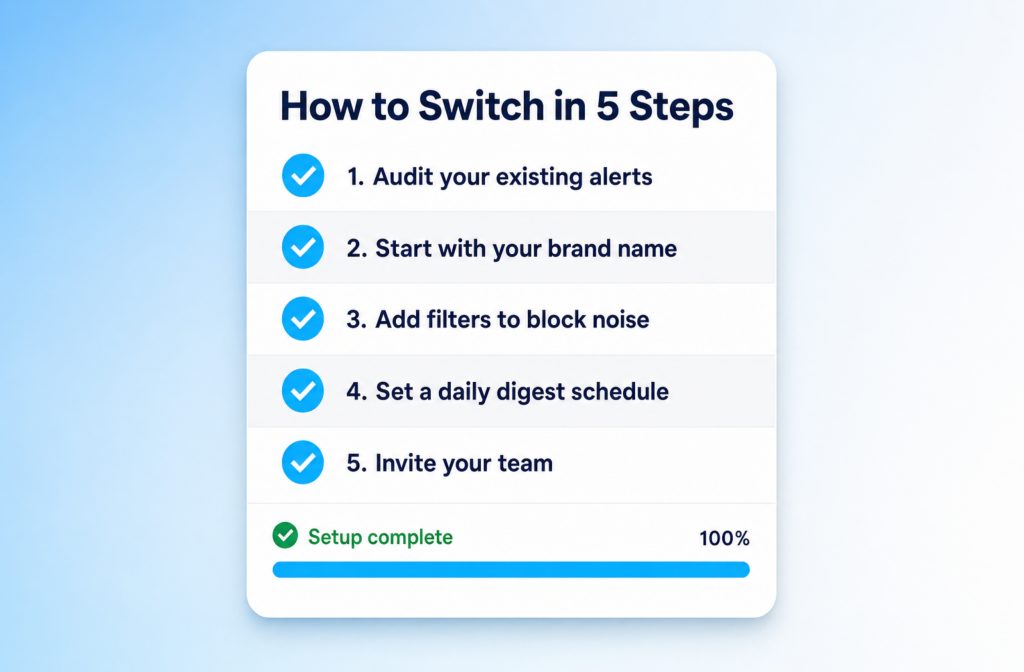
Migrating from Google Alerts to a proper monitoring setup takes less than an hour if you approach it systematically.
Audit your existing alerts first. Open Google Alerts and list everything you are currently tracking. Most people have alerts they set up years ago that no longer match their current priorities. Trim the list before you rebuild it.
Start with your most important keyword. Do not try to recreate every alert simultaneously. Set up your brand name first, get one monitoring cycle under your belt, and then expand to competitors, product names, and industry terms once you know the setup is working.
Add filters immediately. This is the step Google Alerts never let you take. Block your own website. Exclude social profiles you control. Suppress any domains that consistently produce irrelevant results. A filtered alert is worth ten unfiltered ones.
Set a realistic digest schedule. For most brands, a daily digest is the right cadence. It keeps you informed without creating inbox overload. If you are in active PR or crisis communications, you may want more frequent check-ins, but for routine monitoring, daily is sufficient.
Bring your team in early. Brand monitoring is not a one-person job. Marketing, PR, and customer support all have reasons to see what is being said about your brand. Set up role-based access from the beginning rather than forwarding alerts manually.
Frequently Asked Questions
Why did Google Alerts stop sending emails?
Google Alerts has no delivery log, so when it stops there is no explanation and no way to check what was missed. The most common causes are Gmail quietly filtering alerts into Promotions or Spam, or the alert going inactive without notice. Deleting and recreating the alert sometimes fixes it temporarily, but the underlying unreliability does not go away.
Is Google Alerts actually indexing the whole web?
No. Alerts only surfaces what Google’s search index chooses to include, which is optimized for search relevance, not comprehensive coverage. That is why forum threads, niche blogs, and regional news sites are routinely missed even when they contain your exact keyword.
Why does Google Alerts miss so many mentions?
Because the index it pulls from is filtered to serve search queries, not to catch every instance of a phrase. Independent testing found that around 40% of business-relevant mentions never trigger an alert at all.
Can I filter Google Alerts by source type or exclude domains?
No. The only control Google Alerts gives you is the keyword itself. You cannot block specific domains, filter by source type, or exclude your own website from appearing in your own results.
Has Google said it will fix or improve Google Alerts?
No. Google has never publicly committed to improving Google Alerts, and the product has not received a meaningful update in years. The issues described in this article are not bugs on a roadmap; they are the current state of the product.
What is the fastest way to replace Google Alerts?
Set up one alert in a purpose-built monitoring tool, add filters to block noise, and run one daily digest cycle. Most users have a working replacement in under ten minutes and see the coverage difference on the first day.