11 Things Google Alerts Won’t Tell You (But Your Customers Are Saying)

The uncomfortable truth:
Google Alerts captures roughly 40-43% of brand mentions on the open web, according to independent testing by cited.so. That means the majority of what people say about your brand never reaches your inbox. Not because it’s hidden, but because Google Alerts was never built to find it.
Here are the 11 things it silently misses – and why most of them will never show up no matter how carefully you configure your alerts.
1. That Reddit Thread Where 400 People Discussed Your Product
Reddit has become one of the most influential places where brand decisions get made. Someone asks “has anyone used [your product]?” and a thread accumulates 400 comments over three days. Google Alerts captures only about 28% of forum content – and Reddit specifically is even lower, because most of the signal lives in comments, not post titles. You find out about the thread two months later when someone links to it in a support ticket.
2. Every App Store Review Your Customers Left
If your product is in the Apple App Store or Google Play, customers are leaving reviews every week. Some are glowing. Some are brutal. Some describe a bug you fixed six months ago and still show up in searches for your brand name. Google Alerts does not index app store reviews. Zero coverage. You have to check manually or use a dedicated tool.
3. What a Podcast Host Said About You
Podcasts are where industry opinions form. A host with 50,000 listeners spends three minutes comparing you to a competitor, gets the pricing wrong, and says you don’t have a feature you launched eight months ago. That episode will be referenced for years. Google Alerts cannot transcribe audio. It has no access to podcast content unless a text transcript is published on an indexed webpage, which most podcasts don’t bother with.
4. YouTube Comments Underneath Review Videos
A YouTuber publishes a brand monitoring tool comparison. The video gets 30,000 views. The comments section fills up with people asking questions, sharing experiences, and sometimes tagging you directly. Google Alerts indexes the video title and description, but not the comments. The conversation happening directly beneath content about your brand is completely invisible to it.
5. The Negative G2 or Capterra Review Posted This Morning
Third-party review sites like G2, Capterra, and Trustpilot are often the first place a potential customer looks before making a purchasing decision. Google Alerts captures only about 22% of review site content, and coverage varies wildly between platforms. A 1-star review with a misleading title can sit there for weeks, shaping purchasing decisions, while your inbox stays quiet.
6. The LinkedIn Post That Called Out Your Pricing
LinkedIn posts from individual users are not reliably indexed by Google. A founder posts a comparison of three brand monitoring tools, tags their 12,000 followers, and specifically calls out your pricing structure as confusing. Comments pile on. It circulates in industry circles for a week. Google Alerts does not see it. LinkedIn’s walls are largely opaque to Google’s crawlers.
7. What’s Being Said in Private Slack Communities
There are hundreds of industry Slack workspaces where practitioners compare tools daily. Marketing Slack, product management communities, founder groups. “We tried [your product] and switched because of X” is said thousands of times a week across these channels. Google Alerts has no access to private Slack, Discord, or any closed community. This is not a limitation that can be worked around – it is structural.
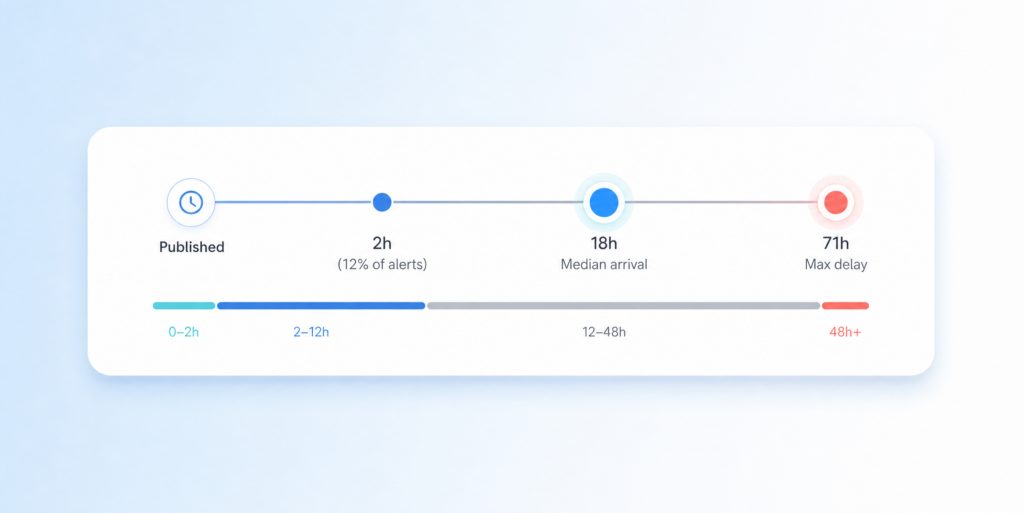
8. The Mention That Arrived 48 Hours Too Late to Matter
Even for content Google Alerts does cover, the delivery is slow. Independent testing has found a median delay of 18 hours for “as-it-happens” alerts, with some taking up to 71 hours. For a product crisis – a bug report going viral, a competitor publicly criticizing you, a journalist asking for comment – receiving an alert two days after the story broke means you are reacting to yesterday’s news. The conversation has moved on without you.
9. How Much Authority the Source Actually Has
Google Alerts sends every mention with exactly the same weight. A passing reference on a spam aggregator site lands in your inbox the same way as a mention in a top-10 industry publication. There is no signal about source authority, audience size, or how much the mention actually matters. You have to evaluate every result manually, which means the tool that was supposed to save you time ends up creating more of it.
10. Your Competitors Being Recommended Instead of You
“What’s the best tool for monitoring brand mentions?” is asked on Reddit, Quora, forums, and community Slack groups constantly. When people answer that question and recommend a competitor without mentioning you, Google Alerts tells you nothing. You are not mentioned, so there is no alert. But those recommendation threads directly affect your traffic, your trials, and your revenue. Tracking competitor mentions and unbranded category keywords is the only way to catch them – and Google Alerts does not support that kind of monitoring reliably.
11. The Mention on a Site Google Hasn’t Indexed Yet
New publications, niche blogs, and industry newsletters sometimes take weeks to get indexed by Google after publishing. A feature in a respected niche newsletter with 8,000 subscribers who are exactly your target customer might trigger an alert in your inbox three weeks after it ran. By then, the window for engaging with that audience has closed. Google Alerts coverage of blog posts sits at roughly 39%, and smaller publications are disproportionately missed.
The Pattern Across All 11
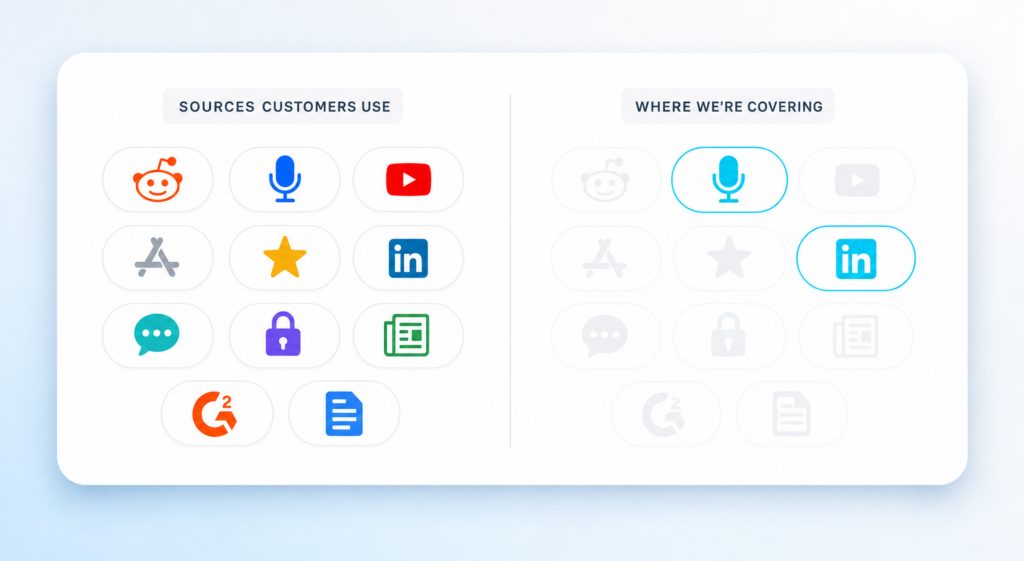
Every gap on this list shares the same root cause: Google Alerts only monitors what Google has indexed, and Google’s index is not the internet. It covers mainstream news, some blogs, and a fraction of discussion content. The places where your customers actually talk – Reddit threads, app reviews, podcasts, YouTube comments, closed communities, review platforms – are largely outside it.
For a free tool you use to stay loosely informed, that is fine. For anyone who needs to know what customers are actually saying in order to protect, improve, or grow a brand, it is not enough. Knowing about a mention 48 hours late, or not at all, is not monitoring. It is archaeology.
A purpose-built monitoring tool covers the sources Google Alerts skips, scores mentions by authority so you focus on what actually matters, and delivers a daily digest that gives you the full picture. Not just the 40% Google happened to index, but the full breadth of where your brand actually lives online.
FAQ
Does Google Alerts cover any social media at all?
Almost none. Google Alerts only monitors content in Google’s web index, and the major social platforms – LinkedIn, Instagram, TikTok, Twitter/X – are not indexed. Reddit has partial coverage, but only for posts, not comments, and coverage is inconsistent depending on whether Google has crawled that specific thread.
Why does Google Alerts miss so many mentions even on regular websites?
Google Alerts depends entirely on Google’s indexing cycle. A page has to be crawled and indexed before it can trigger an alert. Smaller publications, niche blogs, and new sites are often indexed slowly or inconsistently, which is why coverage on regular web content is still only around 40-43% based on independent testing.
Can I fix Google Alerts by setting it to “As-it-happens”?
Not meaningfully. The “as-it-happens” setting controls how often Google Alerts checks for new results and sends emails, not how fast Google indexes new content. Since delivery speed depends on Google’s indexing schedule, even “as-it-happens” alerts arrive with a median delay of 18 hours and sometimes up to 71 hours.
What should I track besides my brand name?
Track common misspellings of your brand name, your product names, your founders’ names, key competitor names, and unbranded category keywords like “brand monitoring tool” or “Google Alerts alternative.” Google Alerts supports all of these in theory, but the coverage gaps described above apply to all of them equally.